How Dance Supports Stress Relief and Mental Health
The holidays are full of hustle, but your dance class might just be the calm you need.
Between work parties, family plans, travel, and never-ending to-do lists, it’s easy to feel like the season is something we’re “getting through” instead of truly enjoying. That’s where dance can become a powerful reset button for your body and your mind.
In this post, we’ll look at how dance and wellness go hand in hand, what the research says about dance and stress relief, and how carving out one weekly class can give you community, confidence, and some much needed “me time” during the holidays.

You’ve probably noticed it already: you walk into class feeling frazzled, and you walk out feeling lighter. That’s not just in your head.
Dance as a form of stress-relieving exercise
Health organizations like the Mayo Clinic and Mental Health Foundation note that physical activity in almost any form can reduce stress by releasing endorphins (your body’s natural “feel-good” chemicals), boosting mood, and helping you step away from your worries. [1][2]
Dance fits beautifully into this category. It gets your heart rate up, uses large muscle groups, and keeps your brain engaged with music and movement. All the ingredients of a powerful stress-relief session.
Several research reviews have found that adults who participate in dance programs show reduced symptoms of depression, anxiety, and stress compared with people who don’t join any movement program. These benefits show up across many styles, from hip hop to ballet to contemporary. [3]
Recent work from researchers in Australia also suggests that a structured dance program (usually at least 6 weeks) can improve psychological and cognitive health just as much as other forms of exercise, and in some cases, dance may even be more engaging and sustainable because it’s fun, social, and creative. [4] [5]
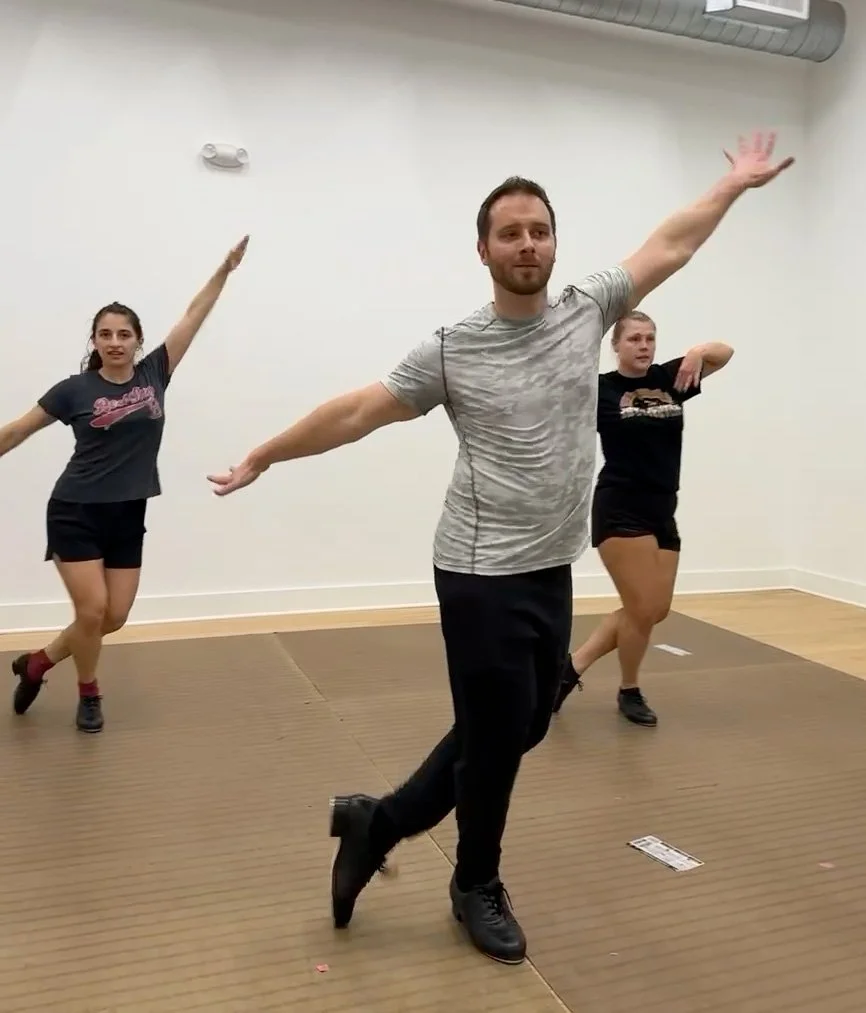
Holiday to-do list on your mind? Tap it out with Patrick and leave class feeling lighter, not busier.
Dancing and the brain
Harvard Medical School has highlighted that dancing doesn’t just move your body; it challenges your brain. Learning choreography, remembering sequences, and coordinating with music can help build new neural connections and support areas of the brain related to memory, planning, and spatial awareness. Dance has also been linked to increased levels of serotonin, one of the brain chemicals associated with mood and well-being. [6]
In other words: that 60-minute adult dance class is doing a lot more than giving you cute choreography for Instagram. It’s literally helping your brain and body regulate stress.
Mindfulness Through Movement: Being Present on the Dance Floor
Meditation doesn’t have to mean sitting completely still. For many adults, especially during a busy season, stillness can feel almost impossible. That’s where mindfulness through movement comes in.
Mindfulness is essentially training your attention to stay in the present moment, with curiosity instead of judgment. Psychologists have documented that mindfulness can improve emotional regulation, reduce stress, and even support better sleep and physical health markers like blood pressure. [7]
Dance naturally invites this kind of focus:
You’re listening to the music.
You’re aware of your feet, your breath, and your balance.
You’re noticing how your body feels as you turn, stretch, or leap.
Studies on “mindful movement” show that combining physical activity with mindful attention can be especially effective for improving mental health and well-being — often more so than either movement or mindfulness alone. [8]
So, when you’re in class and your teacher says, “Let’s take a breath,” or “Really feel that weight shift,” you’re not just learning technique. You’re giving your nervous system a chance to reset. During the holidays, that can be a gift to yourself.
Try this in your next class:
Pick one combo and decide that for that time, you’re going to let your brain only focus on the movement and the music. If your thoughts drift to your to-do list, just notice it and gently bring your attention back to your body. That’s mindfulness through movement in action.
Finding Community and Connection in Adult Dance Classes
The holidays can be complicated. Some people are surrounded by family; others feel more alone than ever. Either way, having a space where you’re seen, welcomed, and cheered on can make a huge difference.
A growing body of research shows that social connection is a key piece of mental wellness. Group activities, especially ones that involve coordinated movement and shared goals, can help reduce feelings of isolation, increase a sense of belonging, and support overall well-being.
Adult dance classes are a perfect example:
You start recognizing familiar faces each week.
You celebrate when someone finally nails that tricky turn.
You laugh together when the whole room turns the wrong way.
During a season where so much energy goes into caring for others — partners, kids, aging parents, colleagues — your dance class can be one of the few places that’s just for you, while still letting you feel part of something bigger.
Carving Out “Me Time” in a Busy Holiday Season
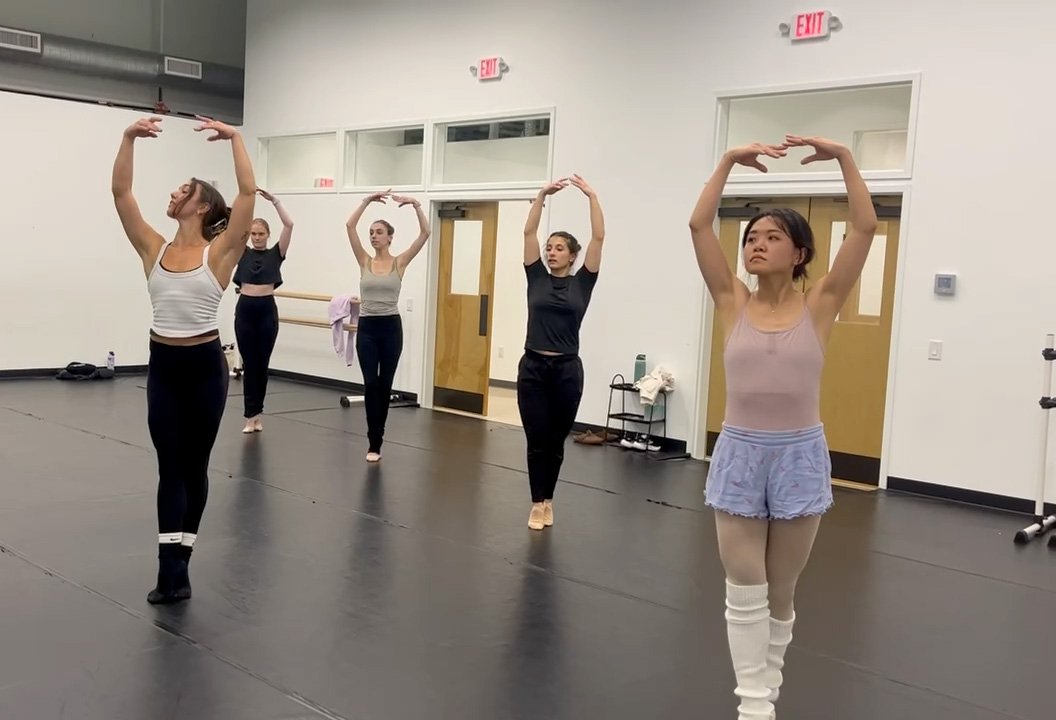
Holiday hustle outside, quiet focus in the studio. Adult ballet with Elizabeth helps you slow down and reconnect with your body.
“Me time” can sound like a luxury during November and December, but it’s actually a tool for staying grounded and emotionally healthy.
Here’s how committing to adult dance classes can help:
Built-in boundaries
When you put class on your calendar, you’re blocking off a pocket of time that can’t easily be given away. You’re not saying, “Maybe I’ll stretch later if I have time.” You’re saying, “On Tuesdays at 7, I’m in the studio.”
That consistent routine is one reason structured programs (like weekly dance classes) are so effective for stress relief and mental health.
A mental reset button
Walking into the studio means you get to step out of your email, your shopping list, and that group text that never ends. Even if you arrive feeling stressed, you know that for the next hour you’re going to move, breathe, and connect with others instead of your inbox.
Permission to be a beginner (again)
As adults, we don’t get many chances to try something just because it feels good. Dance gives you permission to learn, wobble, laugh, and improve — without needing it to be “productive” in the usual sense. That sense of play is incredibly restorative, especially when life feels heavy.
Practical Tips: Making Dance Your Holiday Wellness Habit
If you’d like to lean into dance and wellness this season, here are a few ways to make it stick:
Commit to one class you can realistically keep.
Look at your schedule and pick a time that’s truly sustainable, even on your busiest holiday weeks.Treat class like an appointment with yourself.
You wouldn’t casually skip a dentist appointment. Give your mental health the same respect.Build a simple arrival ritual.
Maybe you change your shoes, take three deep breaths, and mentally “leave the day at the door” before you step onto the floor.Focus on how you feel, not how you look.
Remember: dance is for stress relief, connection, and joy. Your worth is not measured in perfect turns.Invite a friend (or make a new one).
Having a dance buddy can keep you accountable and boost the sense of community that’s so good for your mental health.
Why Adult Dance Classes @ Brookhaven Dance Can Be Your Holiday Calm
If you live or work near Brookhaven, Dunwoody, Sandy Springs, or anywhere in the Atlanta metro area, you don’t need to overhaul your entire lifestyle to feel better this holiday season. Sometimes, it’s as simple as showing up for a weekly class where:
the music is uplifting
the atmosphere is welcoming
the focus is on stress relief, community, and mindfulness through movement.
Over time, the benefits add up: better mood, more confidence, stronger social ties, and a regular space where the only thing on your to-do list is to move.
The holidays will always be busy. But your dance class can be the hour each week when you finally exhale. The calm you carry with you long after the music stops.
When you’re ready for a little calm in the middle of the holiday hustle, we’d love to see you in the studio. At Brookhaven Dance, our classes are designed for real people with real lives. No perfect flexibility or past experience required. Check out our class schedule — we can’t wait to see you in the studio!
References for Further Reading
[1] Mayo Clinic Staff. "Exercise and Stress: Get Moving to Manage Stress." Mayo Clinic (n.d.). https://www.mayoclinic.org/healthy-lifestyle/stress-management/in-depth/exercise-and-stress/art-20044469
[2] Mental Health Foundation. "How to Improve Your Mental Health Using Physical Activity." Mental Health Foundation (2025). https://www.mentalhealth.org.uk/explore-mental-health/publications/how-improve-your-mental-health-using-physical-activity
[3] Moratelli, J. A., et al. "Evidence of the Effects of Dance Interventions on Adults’ Mental Health: A Systematic Review." Journal of Dance Medicine & Science (2023). https://doi.org/10.1177/1089313X231178095
[4] Fong Yan, A., Nicholson, L. L., Ward, R. E., et al. "The Effectiveness of Dance Interventions on Psychological and Cognitive Health Outcomes Compared with Other Forms of Physical Activity: A Systematic Review with Meta-analysis." Sports Medicine 54, no. 5 (2024): 1179–1205. https://doi.org/10.1007/s40279-023-01990-2
[5] University of Sydney. "Dancing May Be Better than Other Exercise for Improving Mental Health." University of Sydney News (February 12, 2024). https://www.sydney.edu.au/news-opinion/news/2024/02/12/dancing-may-be-better-than-other-exercise-for-improving-mental-h.html
[6] Edwards, S. "Dancing and the Brain." Harvard Medical School – On the Brain (2015). https://hms.harvard.edu/news-events/publications-archive/brain/dancing-brain
[7] Davis, D. M., and J. A. Hayes. "What Are the Benefits of Mindfulness? A Practice Review of Psychotherapy-Related Research." Psychotherapy 48, no. 2 (2011): 198–208. https://doi.org/10.1037/a0022062
[8] Remskar, M., Western, M. J., Osborne, E. L., Maynard, O. M., and B. Ainsworth. "Effects of Combining Physical Activity with Mindfulness on Mental Health and Wellbeing: Systematic Review of Complex Interventions." Mental Health and Physical Activity (2024). https://www.sciencedirect.com/science/article/pii/S175529662300073X